
Why Documentation Speed Now Decides Bids
Procurement teams are writing embodied-carbon and traceability checks directly into tender language in 2026. California’s Buy Clean sets material GWP ceilings and requires facility-specific, third-party verified EPDs that are valid at installation, not industry-average PDFs. See the state’s rules and 2025 limits for steel, glass, and insulation on the Department of General Services site (DGS, 2025).
Federal projects funded by the Inflation Reduction Act add their own thresholds for concrete, asphalt, steel, and glass. GSA spells out EPD and PCR conformance, plus a preference for facility-specific data where feasible (GSA, Apr 10, 2025). If your package is missing a compliant EPD or cites the wrong PCR, you lose time and credibility.
What Specialized AI Agents Actually Do
A domain-trained agent assembles the exact documents the buyer expects based on project fit and use case. It parses spec clauses, jurisdiction, and delivery dates, then proposes a package tied to the right plant and time window.
It checks location-specific GWP thresholds, PCR alignment, third-party verification flags, and declared system boundaries. It reads expiry fields, confirms facility identifiers, and maps lot or batch IDs to shipments for traceability across plants.
What Goes Wrong With General-Purpose AI
A general model behaves like an eager but untrained intern. It will scrape scattered files and draft a cover sheet, yet it often grabs an industry-average EPD, a lapsed cert, or a mix design from the wrong plant. Reviewers catch the gaps and the bid moves on.
Without rules tied to the construction demand chain and PCR logic, the model cannot judge whether a 2022 EPD is acceptable for a 2026 installation, or whether the GWP declared as A1-only can be compared to a cradle-to-gate limit. The result is rework and rejection.
The Golden Record Is Non‑Negotiable
This only works if the agent reads from a single, vetted source of truth. In practice that means ERP for plant and batch IDs, PIM or MDM for attributes and version history, controlled LCA data for EPD parameters, and an approved revision log.
Do not let the agent rely on distributor-hosted spec sheets or personal spreadsheets. Teach it which sources are authoritative, which are advisory, and which are off limits. Gate every outbound package through a human review queue when confidence drops.
Minimal List of Documents the Agent Should Assemble
- Environmental Product Declarations (facility-specific where required)
- Mill certificates or heat numbers
- Mix designs and approvals per project spec
- Plant, batch, and lot identifiers mapped to shipment
Practical Path That Fits Real Constraints
Start with one material family and two plants. Map which thresholds and EPD rules hit your top three customer segments. Wire the agent to your PIM or MDM and to a controlled EPD store. Keep the scope narrow until the pass rate is stable.
Add jurisdiction-aware checks as you learn. New York requires EPDs for all concrete mixes on applicable state projects starting January 1, 2025 (NYS OGS, 2025). Caltrans requires EPD submittals for asphalt, concrete, and CMU on projects bid after February 1, 2025 (Caltrans, Aug 21, 2025).
Quality and Audit Safeguards That Matter
Bake in validators that fail closed. Examples include facility match to shipment, PCR version match to what the buyer lists, verification body present, declared modules compatible with the threshold, and install date inside the document’s validity window.
Keep an evidence trail. Every package should include a machine-readable manifest listing document hashes, source systems, and the decision checks that passed. If a reviewer asks why an EPD was chosen, you can show the rule and the data path in seconds.
A Visual to Align Teams
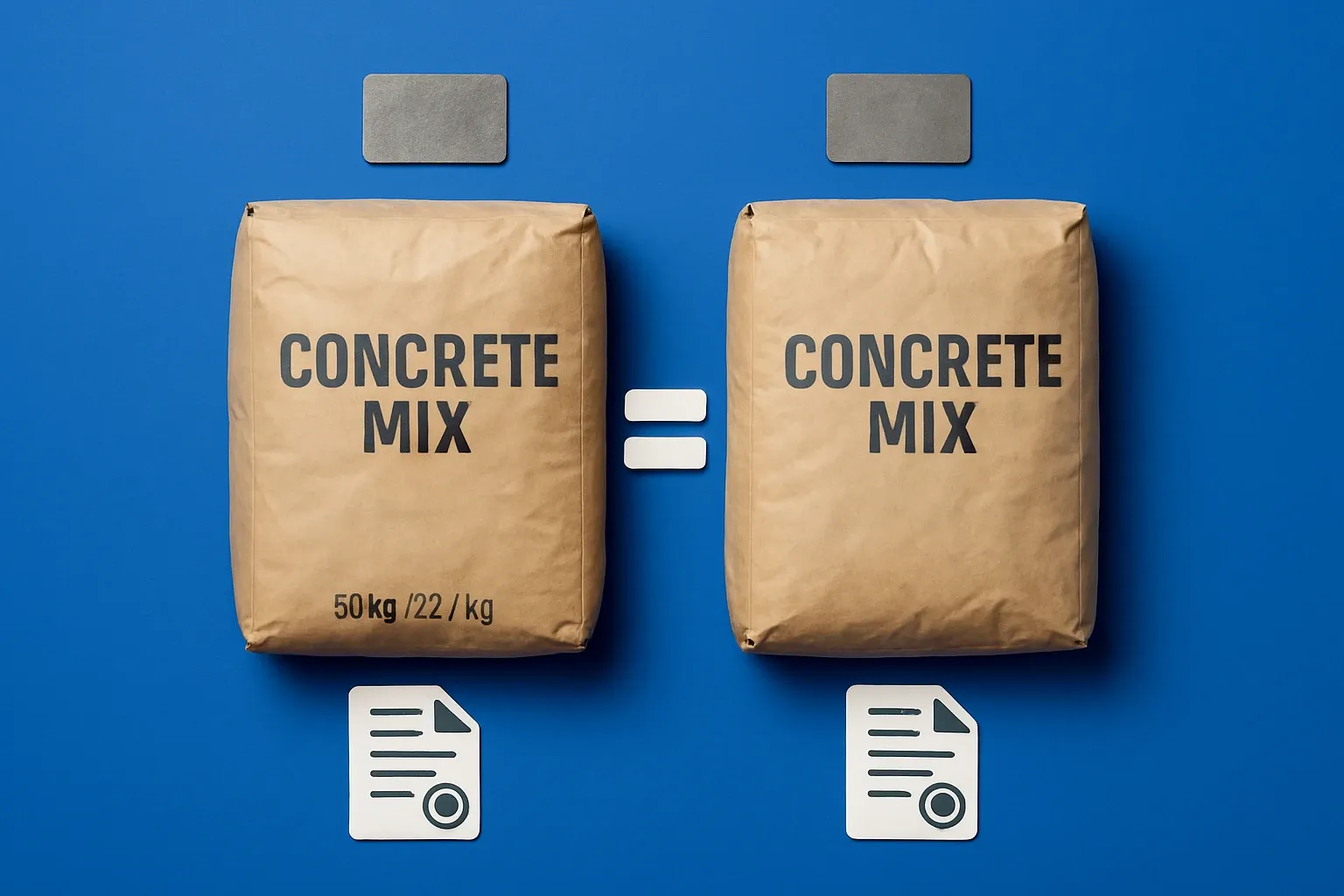
Picture two near-identical concrete bags from different plants on a table with an equals sign between them. Around each bag sit perfectly paired EPD and mill cert “icons.” That is the goal. Same performance in the field, and the same proof on paper because the agent matched documents to plant reality.
Signals You Are On Track
Expect fewer rebids for missing paperwork, faster prequalification, and fewer late-cycle clarifications. Watch internal cycle time from RFP intake to package release, pass rate on first reviewer contact, and the share of submittals assembled from the golden record without manual hunting.
Buyer-Specific Nuance Is The Win
The agent should learn each GC or owner’s preferences and submission portals. Some want a single bookmarked PDF. Others want discrete uploads. Federal work often wants explicit PCR citations by section. The best systems remember and default to what wins with each buyer.
Keep Current As Requirements Evolve
Thresholds and acceptance criteria update regularly in 2025 and 2026. Track the GSA page for IRA low-embodied carbon materials and your key state portals. When a rule changes, update the validator first, then the playbook your teams see.


