

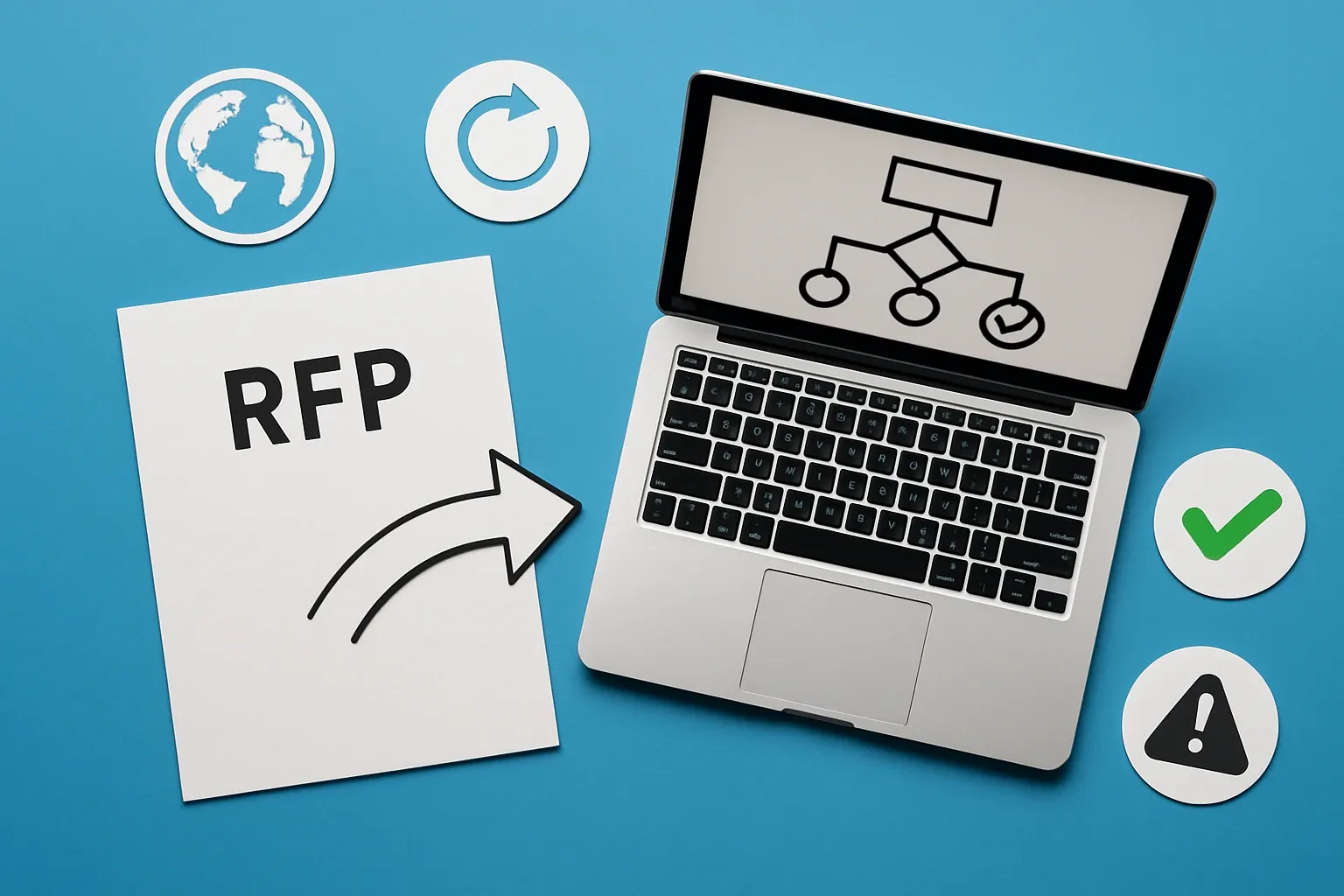
Why Close The Loop Now
Public and private tenders are tightening documentation and domestic content checks. Federal buyers increasingly expect like-kind offers to meet defined salient characteristics, not just similar marketing claims. That is spelled out in the federal “brand name or equal” clause, which requires equality on specified functional or performance characteristics (FAR 52.211-6, 2025).
Domestic sourcing rules are also expanding. For federally funded highway projects, manufactured products face a two-step rollout that adds a 55 percent domestic content test starting October 1, 2026 (FHWA, 2025). GSA’s low-embodied carbon program for concrete, asphalt, steel, and glass continues to require EPD-backed evidence in specific procurements (GSA, updated May 19, 2025).
These changes raise the cost of misconfiguration. GAO reports that while only 16 percent of protests were sustained in FY2024, vendors obtained some form of relief in 52 percent of cases, which still creates delays and rework (GAO, 2024).
Step 1: Extract Requirements Into Normalized Fields
Start by turning free-form RFP text into fields your systems can use. Separate hard constraints from soft preferences. Hard means “must” items like UL listing, Buy America status, or minimum compressive strength. Soft means “preferred” items like color or delivery window. Add conditional constraints such as region, ambient temperature range, seismic zone, or certification triggers.
Use lightweight NLP to label requirement type, unit, and comparator. Store original text, normalized value, and confidence. When in doubt, route low-confidence fields to a review queue instead of auto-accept. Keep a dictionary of common synonyms so “or equal,” “like-kind,” and “equivalent” map to the same substitution policy.
Step 2: Map Requirements To CPQ Attributes And Rules
Create a mapping layer between normalized fields and CPQ attributes, options, and BOM rules. Link hard constraints to compatibility checks and required accessories. For example, a fire rating requirement should lock allowable assemblies and auto-include needed trims or anchors. Prohibited combinations should cancel early with a clear reason code.
Treat conditional logic as first-class rules. If the jobsite temperature minimum is below your product’s cure threshold, swap in a cold-weather variant or force a technical approval stop. If the funding source is a federal-aid highway project after October 1, 2026, enforce the 55 percent domestic content test on affected SKUs (FHWA, 2025).
Step 3: Like-Kind Substitution With Gap And Disclosure
Build a substitution workflow that does three things. First, cross-reference the specified item to candidate SKUs using salient characteristics, not catalog names, consistent with “brand name or equal” principles (FAR 52.211-6, 2025). Second, run a gap analysis that flags any attribute that is inferior, superior, or unverifiable against the requirement set. Third, generate customer-facing disclosure.
Give sales a standard paragraph that cites facts, not fluff. Example: “Proposed alternate meets required compressive strength, slip resistance, and AAMA finish class. EPD available. Buy America documentation attached. Two attributes differ from the basis-of-design item: manufacturer warranty term is 1 year shorter and thickness is 2 mm greater. No change to performance rating.”
Step 4: Traceable Audit Trail End To End
Store a chain that reads requirement to rule to configuration to evidence. The record should show which requirement created which CPQ rule, which rule allowed or blocked which option, and which evidence proved compliance. Link to datasheets, EPDs, mill certs, country-of-origin attestations, and test reports. For GSA projects that invoke low-embodied carbon standards, capture EPD identifiers and version used to calculate global warming potential limits (GSA, 2025).
Make the audit view read-only for sales and bid teams, with export to PDF for submission packets. That single source of truth reduces back-and-forth during clarifications and helps defend decisions if a protest or claims dispute emerges (GAO, 2024).
KPIs That Prove The Loop Is Closed
Track a small set first and expand later.
• Quote cycle time from RFP intake to customer-ready quote. • Exception rate where a human overrode a rule, with reason codes. • Re-quote frequency driven by non-compliance or missing evidence. • Win rate on compliant first submissions versus reworked bids. • Margin leakage from misconfig, measured as post-award change orders that reduce price or increase cost.
Instrument these in your CRM or CPQ using fields that are cheap to capture. Automate the timestamps and reason codes to keep admin work low.
Minimum Viable Implementation In 60 Days
Week 1 to 2, define the top ten hard constraints your quotes miss most and the three most common conditional constraints. Week 3 to 4, build a thin extraction template and a reviewer queue with confidence thresholds. Week 5 to 6, add mapping to your top twenty SKUs and two high-volume assemblies, plus the substitution disclosure paragraph.
Do not pause for a grand taxonomy rebuild. Start with decision-grade attributes, then widen coverage once the KPIs show fewer exceptions and faster cycles.
Data And Governance That Will Save You Later
Keep requirement dictionaries versioned, with change logs. Record who approved each rule and when. For certifications that expire, set reminders and block quoting when evidence is stale. Where federal content or environmental rules apply, store the effective date logic in the rule so past quotes remain explainable if policies change over time (FHWA, 2025).
What Good Looks Like For Bid Teams
RFP intake yields normalized fields in minutes, with low-confidence items queued for review. CPQ eliminates non-compliant paths and attaches evidence automatically. Alternates arrive with transparent gap analysis and prewritten disclosure. The audit trail exports in a click. Sales focuses on scope and value, not on hunting PDFs.
Close the loop from requirements to rules to quotes, and your team stops guessing. They start configuring only what can be delivered, with risks disclosed and compliance proven in the first pass.